
Peptide Works
Research-Grade Peptide Supply
Every resource a researcher could need, from a single reliable source. Manufacturing, testing, formulation, shipping and after-sale support — all held to pharmaceutical-grade standards.

Most peptide suppliers sell vials. Peptide Works is a full-service research supply provider. The difference between the two becomes clear the moment you look beyond the surface.
What we offer is not a vague product catalogue with limited customer care. It is a structured research peptide supply system built from the ground up, fully integrated and capable of managing every aspect of the process: manufacturing and quality testing, formulation and format selection, international shipping, after-sale support, and even the laboratory accessories you need to handle compounds when they arrive.

Peptide Works holds over 220 products in stock across seven distinct product categories, including peptide vials, nasal sprays, pre-mixed peptide pens, capsules, blends, stacks and research accessories. Each category exists because researchers told us they needed it. Our catalog includes options like https://peptide-works.com/gdf-8/, carefully selected based on researcher needs. We did not assemble this catalogue through guesswork or by following manufacturing trends. We built it by listening to how working scientists actually use their laboratories, and then providing the supply infrastructure to deliver consistently, at the quality level those scientists expect.
Every peptide in our catalogue is produced in facilities that are both ISO 9001 and cGMP certified, located in Europe and the United States. Third-party laboratory testing is performed on every batch. All orders ship with a Certificate of Analysis. Regardless of the product category or format, every item is held to a purity standard of 99%, with structurally complex compounds guaranteed at a minimum of 98% purity. These are not aspirational targets. They are operational standards applied to every batch that leaves our facility.
Over the past decade, the research peptide industry has reached a new level of maturity. What was once a fragmented market controlled mainly by small-batch suppliers of variable quality has evolved into a structured environment where researchers are justifiably demanding pharmaceutical-grade manufacturing standards, readily available testing documentation and dependable international logistics.
That evolution has raised the bar for every supplier in this space. At Peptide Works, we have not simply kept pace with those rising expectations — we have designed our entire operation around exceeding them. Each service described on this page represents a realisation of that commitment, from the way our peptides are synthesised to how they are packaged, shipped, tracked and supported after delivery.

The lyophilized peptide vial remains the most widely used format in laboratory peptide research, and for good reason. It provides full control to the researcher. You choose the solvent. You set the concentration. You decide when to reconstitute. For experiments where every variable counts, this degree of freedom is not a luxury it is a necessity.
Peptide Works offers more than 55 individual compounds in vial form, making this the single largest category in our catalogue. Inside each vial is freeze-dried peptide powder, sealed in custom-selected glass that has been specifically chosen to prevent peptides from binding to the container walls. Some peptide sequences can adhere to standard laboratory glass, reducing yield upon reconstitution. We select our glassware deliberately to address that issue, so that what you reconstitute in your laboratory is as close to the tested compound as physically possible.
Each vial product is produced on a rolling production schedule rather than sitting in warehouse stock for extended periods. The result is a fresher product with improved stability characteristics from the moment it arrives on your bench.
The compounds available in vial format encompass a wide range of research applications. These include growth hormone secretagogues like https://peptide-works.com/the-best-muscle-growth-peptide/, neuroprotective peptides, tissue repair molecules, immune modulators, metabolic regulators and ageing-related biomolecules. Whether your work involves cellular signalling pathways, hormonal axes or wound repair mechanisms, the vial catalogue is designed to support it.
Purity is confirmed for every batch by an independent third-party laboratory, with the results compiled into a Certificate of Analysis that ships with your order. HPLC chromatography assesses the level of purity and mass spectrometry confirms the molecular identity. A batch that does not reach our 99% purity threshold or 98% for complex peptides will not ship. That rule allows for no exceptions.
From a practical standpoint, the vial format also has advantages in terms of storage and shelf life. When peptides are lyophilized, they can remain stable for two to five years, provided they are stored in a cool, dry environment away from direct sunlight. That extended shelf life means researchers can order ahead of studies with confidence that the material will not degrade immediately, and it provides a degree of protection against the supply chain disruptions that occasionally affect the research materials market.

Reconstitution is straightforward, and our resource pages provide recommendations on appropriate solvents to use and how to store reconstituted solutions when you are ready to begin working with the peptide.
Driven by strong research demand and the unique advantages that nasal delivery offers for certain classes of compounds, nasal sprays have emerged as one of the fastest-growing product categories in research peptides. The nasal mucosa provides direct absorption that bypasses first-pass metabolism, making this route especially relevant for researchers investigating neurological pathways, mood regulation, systemic peptide distribution and compounds with known bioavailability challenges through alternative delivery routes.
Peptide Works carries over 55 nasal spray products, available in both 15ml and 30ml sizes. What sets our nasal sprays apart is precision engineering. Every spray device is designed to consistently deliver a precise amount with each actuation. This matters in research: reproducibility is not optional. If your dosing varies from one actuation to the next, that variance carries through into your data. Our spray formulations are developed to ensure that every dose is as uniform as the delivery mechanism allows, giving researchers the confidence they need.
Our nasal spray range includes both single-compound sprays, which cover the full spectrum of commonly researched peptides, and multi-compound nasal stacks that combine two complementary compounds within a single spray device. Available stacks include Semax paired with Selank for cognitive and anxiolytic research, PT-141 with Oxytocin, BPC-157 with KPV, Epithalon with Thymalin, DSIP with Epithalon, PT-141 with Kisspeptin, Thymosin Alpha-1 with LL-37, VIP with BPC-157, BPC-157 with TB500, and growth hormone axis combinations such as HGH Frag 176–191 with CJC-1295 DAC and GHRP-6 with CJC-1295 No DAC.
Each nasal stack contains a specific ratio of each component, with independent testing and a full Certificate of Analysis accompanying every product. The convenience of a multi-compound nasal spray does not come at the expense of quality assurance. Every component meets the same purity standard required of individual products.
The availability of 15ml and 30ml sizes gives researchers the flexibility to match their supply to the scale of their study. Smaller volumes are appropriate for pilot studies and initial investigations, while larger volumes support extended protocols and higher-throughput work. Both sizes deliver an equally calibrated dose per actuation, so switching between the two does not introduce variability into your data. Some laboratories simply prefer the larger format because it reduces restocking frequency, which is particularly helpful in longitudinal studies or repeat-measure designs.
Not every laboratory has the time or inclination to reconstitute lyophilized peptides from powder for every study. That practical reality led to the development of pre-mixed peptide pens. These are fully prepared peptide solutions, already loaded into pen-style delivery devices and ready for use immediately upon receipt.
Peptide Works offers more than 50 pre-mixed pen products encompassing a wide range of compounds from the catalogue. In pen format, the reconstitution step is removed entirely — there is no powder to dissolve, no solvent to measure and no waiting for the compound to go into solution. You open the packaging and the peptide is ready.
The pen format offers genuine workflow advantages for researchers running high-throughput protocols or working in environments where minimal preparation time and fewer handling steps are priorities. Every minute saved in preparation is a minute reserved for the research itself. Those minutes add up, particularly in large-scale studies where dozens or hundreds of administrations may be needed.
Despite the convenience, there is no loss in quality. The peptides used in our pre-mixed pens are synthesised, assayed and certified to exactly the same quality standards as our vial products. The purity guarantee applies. The independent testing applies. A Certificate of Analysis is included. The only difference is the format — the quality standards remain identical.
The pen devices themselves are designed for ease of use and precision in dosing. Consistent delivery volumes ensure reproducibility, which is the core purpose behind the pre-mixed format. The pen format would serve little function if it did not perform reliably.
Researchers sometimes ask whether the trade-off in flexibility — you cannot adjust the concentration as you would with a reconstituted vial — is worth the convenience. The answer depends entirely on your protocol. If your study requires a standardised concentration, the pen format allows you to skip a complete preparation step from your workflow while still working with a high-quality product. For studies that need custom concentrations, vials are the better option. Having both in the catalogue means you are never forced to adapt your science to fit a format. You choose the format that fits your science.
Capsules hold a specific and valuable place in peptide research. They are not suitable for every study, but in situations where they apply, they provide a level of convenience and standardisation that is difficult to achieve through other formats.

Peptide Works provides high-purity bioactive peptides in standardised oral dosage forms designed for research use. Current capsule offerings include 5-Amino-1MQ, BPC-157, Epithalon, GHK-Cu, KPV, MK-677, Tesofensine and a combined capsule of BPC-157 with Thymosin Beta-4. Each of these compounds was selected for capsule formulation based on its relevance to research protocols where oral dosage forms are applicable.
The capsule format is well suited to studies assessing oral bioavailability, metabolic responses following peptide administration, comparative research across delivery methods and dose-response relationships. Standardised dosages remove a variable that can introduce noise into experimental data — the variability inherent in manual preparation and measurement.
All compounds used in our capsule products are held to the same purity and testing standards as every other area of the catalogue. Capsules are not a secondary product line. They represent the same quality commitment in a different delivery format, produced under the same cGMP and ISO 9001 certifications and verified through the same independent third-party analysis process.
We continue to expand the capsule range as we identify additional compounds that genuinely benefit from oral dosage formulation. Every addition to the capsule catalogue undergoes an identical vetting and testing process. We will not add capsules simply to expand the catalogue — we do so when the compound, the format and the needs of the research community are all properly aligned.
Some of the most compelling peptide research involves interactions between two or more compounds. That is often where the most interesting discoveries occur. This type of work is supported by two specific product categories at Peptide Works: blends and stacks.
A peptide blend is a single vial containing two or more complementary peptides at precisely defined ratios. The compounds are co-formulated, meaning the researcher administers one product rather than several individually reconstituted vials. Peptide Works offers a range of blends including BPC-157 with TB500, GHRP-6 with CJC-1295 DAC, GHRP-6 with CJC-1295 No DAC, HGH Frag 176–191 with CJC-1295 DAC, Ipamorelin with CJC-1295 No DAC, and Ipamorelin combined with HGH Frag 176–191 and CJC-1295 DAC.
A peptide stack is a multi-vial or multi-format package where peptides are collected for coordinated use, but each compound remains in its own container. Stacks allow researchers to work with each peptide individually while following a combined study design. Available stacks include AOD-9604 with BPC-157, BPC-157 with GHK-Cu and Thymosin Alpha-1, BPC-157 with TB500 and GHK-Cu, BPC-157 with VIP, Epithalon with DSIP, KPV with BPC-157, Selank with Semax, Tesamorelin with Ipamorelin, and Thymalin with Epithalon, among others.
The practical benefit of both formats is clear — they simplify multi-compound research protocols. Researchers can work with products already formulated to be compatible, rather than sourcing each peptide separately, checking compatibility or calculating ratios. Every component in each blend and stack is tested independently by a third party, with Certificate of Analysis documentation for each compound. The purity commitment extends to every element, not just the finished product.
The pairings within blends and stacks are not random. The combinations reflect established knowledge about interactions or complementary actions of specific peptides within specific biological pathways. Growth hormone axis studies often combine a secretagogue with an analogue of the releasing hormone — which is why pairings such as Ipamorelin with CJC-1295 or GHRP-6 with CJC-1295 appear in both our blend and nasal stack ranges. Tissue regeneration research frequently involves compounds that target similar but non-identical recovery processes, which is why BPC-157 is often paired with TB500 or GHK-Cu. The science drives the formulations.
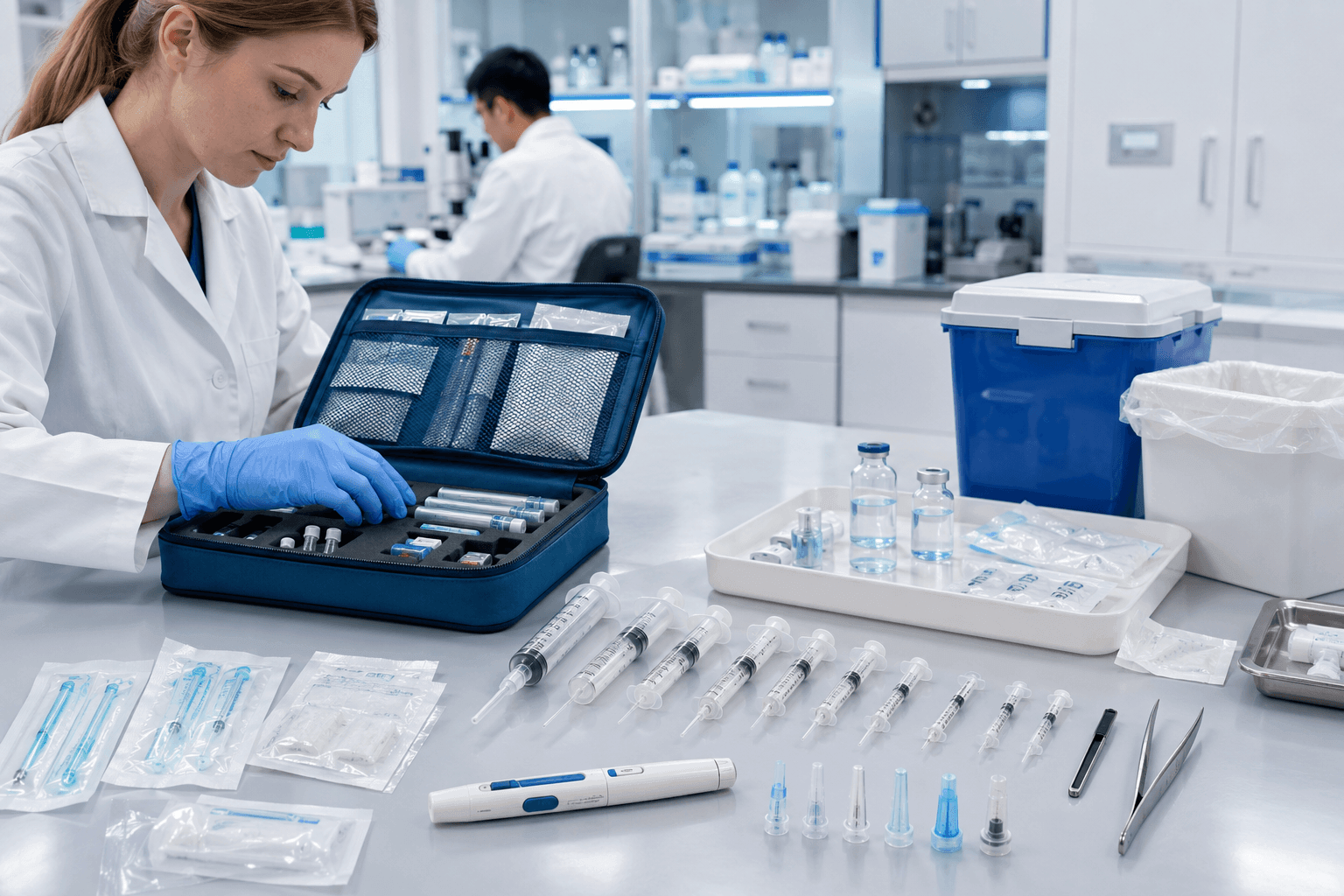
Without proper accessories, a peptide is a reagent missing its pipette — theoretically present but practically incomplete. From the beginning, Peptide Works recognised that researchers should not have to source their laboratory accessories from a separate supplier. That is why we carry a complete line of accessories designed to support every product format in our catalogue.
The accessory range includes fixed-needle empty syringes in three gauge sizes (27g, 29g and 30g), accommodating the most common requirements of peptide research applications. For researchers working with our pen format, we provide injection pen needle packs, empty pen cases, empty cartridges designed specifically for peptide pens and a deluxe set that includes a pen with an empty cartridge. Reconstitution supplies include bacteriostatic water and sterile water in 2ml vials. Commonly needed preparation and safety items include alcohol wipes, sharps safes, disposal bins for used needles and comprehensive peptide accessory kits that bundle the most frequently required items together.
The value of sourcing accessories from the same supplier as your peptides goes beyond convenience. The materials we provide alongside our products have been selected to be compatible with peptide research. By obtaining all of these items from a single source that understands how the pieces work together, you reduce the risk of incompatibility and simplify your procurement process. One order, one shipment, everything you need to begin.

Whether you are establishing a new peptide research workflow or you are part of an established laboratory looking to streamline the supply chain, the peptide accessory kit brings together the most commonly needed items in a single package. It removes the guesswork of determining what you need beyond the peptides themselves, and it ensures that nothing essential is missing when you are ready to start. The sharps safes and disposal bins address the disposal side of laboratory work — something that can be overlooked during ordering but becomes immediately important once research begins.
Quality is not simply one section of our services. It is the foundation that gives meaning to everything else. If the peptide is not what it claims to be, then nothing else matters — not how fast the shipping is, not the format, not how helpful the customer support team might be. Quality assurance is the most important service we provide, and at every level of our organisation, our processes are designed to support this commitment with validated evidence rather than vague assurances.
All peptides offered by Peptide Works are produced in facilities that hold both cGMP and ISO 9001 certification, located in Europe and the United States. cGMP certification means that every step of the production process occurs according to documented, validated procedures in controlled environmental conditions. ISO 9001 certification provides an overall framework for quality management that describes how processes should be monitored, measured and improved over time. Together, these certifications represent the highest level of manufacturing quality typically accessible within the research peptide market.
Peptides are not manufactured in large volumes and stored. They are produced on demand, ensuring that what you receive is as fresh as possible with optimal stability characteristics. All items are stored in temperature-controlled environments prior to shipping to preserve integrity. Vial products, for example, use glass vessels specifically selected for their low capacity for peptide absorption during storage.
Every batch goes directly to an independent laboratory for testing. These laboratories have no financial connection to our manufacturers. They receive blinded samples, perform their analyses and report results without any pressure or incentive to produce favourable numbers. Testing typically includes HPLC chromatography for determining purity and mass spectrometry to confirm molecular identity.
A Certificate of Analysis accompanies each order, outlining the findings from that testing in detail. The Certificate of Analysis is not a general stamp of approval. It is an extended analytical report describing what was tested, how the tests were conducted and what the results were at each stage. Researchers can use the Certificate of Analysis to confirm the identity and purity of compounds before incorporating them into their work, as well as to maintain traceable records for publications or audits.

We guarantee 99% or higher purity for standard peptides and a minimum of 98% for structurally complex compounds. If a product fails the purity specification, it is not shipped. If a product reaches a customer and does not meet expectations, we reissue the order at no charge. That guarantee is not limited by time or conditions. It reflects our confidence in the testing process and our willingness to stand behind it.
Lyophilized products that are stored correctly can remain stable for two to five years. After reconstitution, peptides stored between two and eight degrees Celsius will maintain their integrity for at least twenty-four weeks. Storage instructions accompany our products, because how a compound is handled after delivery matters just as much as the care taken during production.
We ship to researchers in most countries worldwide, dispatching from both UK and US-based fulfilment points. The majority of orders are shipped from the United Kingdom, with US-based fulfilment used when it offers faster or more efficient delivery routes for the customer.
Orders are dispatched within 24 to 48 hours after payment is confirmed. That turnaround is not discretionary — it is the standard processing window. Every order is assigned a tracking number upon dispatch so that you can follow your shipment from our facility to your door.
Two shipping tiers are available. Standard Shipping offers delivery within approximately 10 to 14 days with full tracking included. For researchers working to tighter timelines, Premium Shipping shortens the delivery window to 3 to 5 days. Carrier partners include established names such as Parcel Force and DHL, selected for their reliability and global coverage. Shipping costs may vary by destination and will be confirmed at the time of order.
Every order is shipped in plain, unmarked packaging. There is no external indication of the contents. A return address is included for logistical purposes only, with full privacy maintained. This is standard for every order — there is no need to request it.
Packaging is designed with product integrity firmly in mind. Peptides are sensitive to heat, moisture and physical disruption. Our packaging protocols include moisture-resistant sealing and appropriate insulation, ensuring that products leave our facility in the same condition in which they arrive at your laboratory.
For researchers who want an additional layer of security, we offer a Shipping Protection option. This service guarantees delivery of your order. If a shipment does not arrive within 21 days of dispatch for Premium Shipping, or 28 days for Standard Shipping, we reship at no charge. If the reshipped order also does not arrive, you receive a full refund. Shipping Protection covers customs delays, lost packages and any other non-delivery scenario. Approximately 2 to 3 percent of international orders are affected by customs holds at any given time, and this service protects researchers from that risk.
Customs rules and regulations vary from one country to another. Peptide Works cannot reasonably be expected to maintain encyclopaedic knowledge of every country's import requirements, and we encourage researchers to check local regulations before placing an order. However, Shipping Protection completely removes the financial risk of a customs hold. The service was designed specifically for that purpose: to provide international researchers with peace of mind, ensuring that a customs process beyond their control does not become an additional financial burden on top of a logistical delay.
We have shipped to researchers located in Europe, North America, Australia, Asia and further afield. That breadth of experience has taught us valuable lessons about the particular logistical challenges different regions present — from customs processing durations to local carrier reliability and seasonal shipping delays. Every lesson learned over the years has been incorporated into our logistics processes, making them more efficient and resilient. When a researcher in Tokyo, Toronto or Tallinn places an order, the fulfilment process reflects years of operational experience in getting peptides from one location to another, both domestically and internationally.

Not every supplier offers a support team. Peptide Works does. We provide customer support at every stage of the research procurement journey: product selection before purchase, delivery assistance during fulfilment, and ongoing guidance after your order arrives.
Our team can help you identify the correct product and format for your specific research needs before you place an order. If you are unsure whether a vial, nasal spray or pre-mixed pen is better suited to your protocol, we can walk you through the differences and help you make an informed choice. If your study involves multiple compounds, we can guide you toward the blends or stacks that might simplify your workflow.
Payments are accepted in GBP, USD, EUR and CAD, making the process straightforward for research institutions and individual researchers regardless of location. Our support team monitors fulfilment and is available to answer questions about delivery times, package tracking or any issues that may arise during transit.
Once your products arrive, the support does not stop. Researchers frequently have questions about storage conditions, reconstitution guidance or how to interpret a Certificate of Analysis, as well as advice on working with specific compounds. Our team understands the products we supply and their applications, so we are prepared to have those conversations.
We respond promptly if something goes wrong. Damaged packages are replaced and reshipped at no charge. Shipping Protection ensures lost shipments are resent without delay. Orders are eligible for cancellation with a full refund provided they have not yet been processed, and we encourage researchers to submit cancellation requests as soon as possible after placing an order, given that processing begins within 24 to 48 hours of payment confirmation.
At Peptide Works, customer relationships extend well beyond the point of sale. Our success is not measured by a single transaction but by how many researchers return for their second, fifth or twentieth order. That kind of loyalty is built on consistent quality and genuine responsiveness.
We also recognise that researchers work in different contexts and have different needs. The expectations that accompany a small academic laboratory order for a handful of vials differ from those of a larger contract research organisation ordering across multiple compound categories. Our support team adapts accordingly. We avoid a one-size-fits-all communication style. We respond to what each customer needs — whether that is a brief email confirming a tracking update or a more detailed conversation about which formulation might best suit a transition into new research. We do not advertise that flexibility widely. It is simply how we work, and repeat clients tend to notice it.

While our primary role is supplying the highest quality peptides, we also believe that a responsible supplier should give back to the community by enriching its knowledge base. Peptide Works offers multiple educational resources designed to support researchers at every level of experience.
We regularly publish articles on our blog covering peptide compound profiles, emerging research directions and practical information on the technical aspects of laboratory peptide work. Recent topics have explored tissue repair pathways, cellular energy metabolism, oxidative stress mechanisms and the evolving role of peptides in immunology and neuroprotection research. These articles are written for a research audience and provide depth well beyond a standard product description.
In addition to the blog, we maintain dedicated pages covering fundamental aspects of peptide science for researchers who want a deeper understanding. These resources explain what peptides are, how they are developed, the types of bonds between them, their properties, grading and purity standards, as well as detailed guidance on peptide reconstitution. We also maintain a comprehensive listing of popular peptides, profiling compounds that are most consistently sought after for research purposes, along with information about structure, mechanism of action and relevant published research.
Every product comes with storage and handling guidelines, which are also available through our resource pages. Proper post-delivery handling is essential to maintaining the integrity of research materials, and we want every researcher ordering from us to have the knowledge needed to store and work with their peptides correctly. Lyophilized peptides that are stored properly can remain stable for two to five years. Reconstituted peptides should be refrigerated between two and eight degrees Celsius, where they will maintain their integrity for at least four weeks.
At Peptide Works, education and supply are not separate activities. They are two sides of the same commitment. When one of our compounds reaches a researcher, they have both the material and the context needed to use it most effectively.

The practical value of these resources often reveals itself in ways that are easy to overlook. A scientist who understands the correct reconstitution method does not waste material through failed preparation. A laboratory technician who knows the appropriate storage temperature range does not inadvertently degrade a compound by leaving it at room temperature. A principal investigator who can read a Certificate of Analysis confidently makes more successful procurement decisions. None of these are dramatic outcomes, but they are the kind of incremental improvements that compound over time and make the difference between a research programme that runs smoothly and one that stumbles through avoidable mistakes. It is precisely these improvements that our educational resources are designed to support, quietly and consistently.
Not a single service described on this page — whether it is product supply, quality assurance, shipping, customer support, accessories or educational materials — exists for any reason other than to provide researchers with the tools and confidence to do meaningful work.
That is what motivates this company. It is what drove us to build the infrastructure we have, and every step we take as we grow will be guided by the same principle. The science matters. The researchers conducting that science matter. And the services that support their work should reflect that importance.